SEARCH
Advanced Search
ABOUT
Site Map
CP RSS Channel
Contact Us
Sponsoring CP
About Our Sponsors
NEWS
Cover Stories
Articles & Papers
Press Releases
CORE STANDARDS
XML
SGML
Schemas
XSL/XSLT/XPath
XLink
XML Query
CSS
SVG
TECHNOLOGY REPORTS
XML Applications
General Apps
Government Apps
Academic Apps
EVENTS
LIBRARY
Introductions
FAQs
Bibliography
Technology and Society
Semantics
Tech Topics
Software
Related Standards
Historic
|
| DMTF Common Information Model (CIM) |
Contents
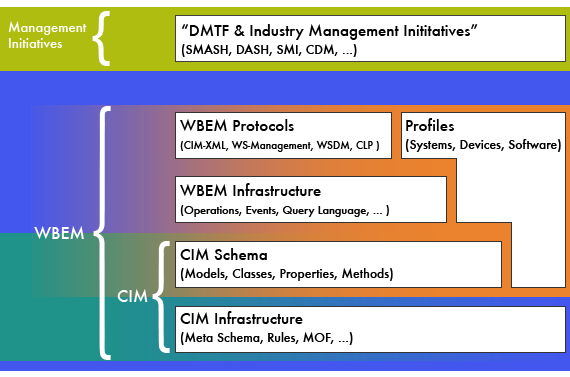
Distributed Management Task Force (DMTF) technologies are designed to work together to address the industry's needs and requirements for interoperable distributed management. These standards provide well-defined interfaces that build upon each other, delivering end-to-end management capabilities and interoperability. The foundation of the DMTF's technologies is the Common Information Model (CIM). The CIM Infrastructure specification defines CIM's 'rules' and provides the details for integration with other management models. CIM-XML is a WBEM protocol that uses XML over HTTP to exchange Common Information Model (CIM) information. The next layer is the CIM Schema, which delivers semantically rich, object-oriented model descriptions for all managed elements. The CIM Schema facilitates streamlined integration and reduced costs by enabling the exchange of management information in a platform-independent and technology-neutral way. CIM Schema includes MOF files, Final XML Classes, and Final XSD classes.
Building upon CIM is the DMTF's Web-Based Enterprise Management (WBEM), a set of management and Internet standard technologies developed to unify the management of distributed computing environments. WBEM provides the ability for the industry to deliver a well-integrated set of standard-based management tools, facilitating the exchange of data across otherwise disparate technologies and platforms.
As an extension of the DMTF's Common Information Model (CIM), the Common Diagnostic Model (CDM) specification is widely used within the industry to evaluate the health of computer systems in multi-vendor environments. CDM creates diagnostic instrumentation that can be utilized by platform management applications, and its tight synergy with the other manageability domains in CIM further enables integration of diagnostics into critical management functions.
DMTF management initiatives (from the DMTF, as well as other industry organizations) are built upon DMTF technologies. These initiatives, which deliver functionality to specific vertical applications and industries, include important implementations such as the DMTF's Systems Management Architecture for Server Hardware (SMASH) and Common Diagnostic Model (CDM), as well as the Storage Networking Industry Association's (SNIA's) Storage Management Initiative Specification (SMI-S).
DMTF is an industry organization "leading the development of management standards and integration technology for enterprise and Internet environments. DMTF's focus is to develop and unify management standards and initiatives for enterprise and Internet environments. Working with key technology vendors and affiliated standards groups, DMTF is enabling a more integrated and cost effective approach to management through interoperable management solutions. The use of DMTF standards ultimately lowers operational costs.
[December 16, 2003] New DMTF Server Management Working Group to Evolve CIM Specification. An announcement from the Distributed Management Task Force (DMTF) describes the formation of a new DMTF Server Management Working Group formed by Dell, HP, IBM, Intel, AMD, Microsoft, Oracle, OSA Technologies, Sun Microsystems, and several other technology companies. The goal of the Server Management Working Group is to "define a platform independent, industry standard management architecture instantiated through wire level protocols built upon IP based technologies. The focus of the WG is management of server system hardware; this includes interactions with the operating system that are necessary to assist in hardware management." The architectural model will "extend the Common Information Model (CIM) schema to represent new server system topologies; it will define the syntax and semantics of a Command Line Interface (CLI) protocol, leveraging the CIM/XML protocol and identifying enhancements as necessary. The group will define profiles for different server system topologies in order to support base-level compliance, and will document an architectural model for understanding the semantic behavior of server management components." Initial deliverables identified for July 2004 include a lightweight command line interface specification, lightweight CIMOM and supported CIM operations specification, and standard server system topology profiles. Phase 2 deliverables for December 2004 include a compliance specification, test cases for interoperability, and interoperability testing data. Liaison relationships are expected to be formed with relevant OASIS TCs, the Storage Management Initiative (SNIA), W3C Working Groups, and the Service Availability Forum.
[March 18, 2003] DMTF Publishes Three Final XML Specifications for Web-Based Enterprise Management. The Distributed Management Task Force (DMTF) has published 'final status' versions of three WBEM Specifications. Web-Based Enterprise Management (WBEM) is a set of management and Internet standard technologies developed to unify the management of enterprise computing environments. The Common Information Model (CIM) is an object-oriented information model defined by the DMTF which provides a conceptual framework for describing management data. Specification for the Representation of CIM in XML, Specification for CIM Operations over HTTP, and CIM XML Document Type Definition represent the core set of standards defining the WBEM infrastructure. "These standards describe the encoding of the Common Information Model (CIM) using XML (xmlCIM), and define operations and the transport mechanism for the encoded data (CIM Operations over HTTP). CIM is defined by a Specification, which describes its basic modeling concepts and meta-schema design, as well as the Managed Object Format (MOF) language in which it is rendered; and a Schema, which defines the semantics for a wide range of managed objects and relationships between them. CIM serves as the data model for the WBEM Specifications, and enables applications to manage a networked environment end-to-end."
The industry organization Distributed Management Task Force, Inc. (DMTF) is developing CIM as "a conceptual information model for describing management that is not bound to a particular implementation. This allows for the interchange of management information between management systems and applications. This can be either 'agent to manager' and 'manager to manager' communications which provides for Distributed System Management. There are two parts to CIM: The CIM Specification and the CIM Schema. The CIM Specification describes the language, naming, Meta Schema and mapping techniques to other management models such as SNMP MIBs, and DMTF MIFs etc. The Meta Schema is a formal definition of the model. It defines the terms used to express the model and their usage and semantics. The elements of the Meta Schema are Classes, Properties, and Methods. The Meta Schema also supports Indications and Associations as types of Classes and References as types of Properties. The CIM Schema provides the actual model descriptions. The CIM Schema supplies a set of classes with properties and associations that provide a well-understood conceptual framework within which it is possible to organize the available information about the managed environment." [from the FAQ]
[May 23, 2002] SNIA Announces Bluefin SAN Management Specification Using WBEM/MOF/CIM. The Storage Networking Industry Association (SNIA) has acknowledged receipt of a draft specification for a "proposed common interface for SAN [Storage Area Network] management that can reliably identify, classify, monitor and control physical and logical resources across the enterprise using a common transport for communication. The specification, code-named 'Bluefin,' employs technology from the Web Based Enterprise Management (WBEM) initiative that uses the Managed Object Format (MOF) to describe system resources based on a Common Information Model (CIM). Bluefin introduces new technology for security, locking, and discovery for SAN management. The Distributed Management Task Force (DMTF) and SNIA have been in close collaboration for several years in anticipation of driving improved storage management interoperability. DMTF has developed WBEM, a standard set of web-based enterprise management tools that unify management of enterprise computing environments. WBEM includes a data model, the Common Information Model (CIM), an encoding specification based on Extensible Markup Language (XML), and a transport mechanism based on Hypertext Transport Protocol (HTTP). CIM is an object-oriented information model that provides a conceptual view of physical and logical system components. Taken together, these technologies provide the tools to build reliable, scalable, multi-vendor SAN management solutions." [Full context]
[October 19, 1998] Version 1.0 of the DMTF's CIM XML encoding specification was announced on October 19, 1998. The announcement said, in part: "The XML Encoding Specification defines XML elements, written in Document Type Definition (DTD), which can be used to represent CIM classes and instances. As part of the DMTF's Web-based Enterprise Management (WBEM) roadmap, the XML specification will enable companies to leverage Web technologies to manage enterprise systems. The Common Information Model (CIM) is an object-oriented information model standardized within the DMTF for the purposes of providing a conceptual framework within which any management data may be modeled. Allowing CIM information to be represented in the form of XML, brings all of the benefits of XML and its related technologies to management information modeled using the CIM meta-model. WBEM is a set of management and Internet standard technologies developed to unify the management of enterprise computing environments. It provides the ability for the industry to deliver a well-integrated set of standards-based management tools, leveraging emerging technologies such as XML and CIM."
As of June 1998, a working group had been formed to develop XML encodings for the exchange of WBEM's CIM (Common Information Model) data. Several XML specifications relating to XML encoding for CIM information were approved by the DMTF Board on October 6, 1998. "XML encodings would let mainframes, Windows-based systems, and other disparate systems access and exchange management data via the Web, according to Victor Raisys, general manager of the Windows NT Server Group at Microsoft, in Redmond, Wash." The Web-Based Enterprise Management (WBEM) initiative, developing web data management standards, transferred the WEBM work to the Desktop Management Task Force [June 1998].
[August 11, 2008] Open Virtualization Format Specification. DMTF Document Type: Specification. Document Number: DSP0243. Publication date: 2008-07-09. Version: 1.0.0b. 41 pages. Status: "Work in Progress, expiring October 10, 2008 [or: September 30, 2008]." Copyright © 2008 Distributed Management Task Force, Inc. (DMTF). Normative ANNEX C presents the OVF Schema (XSD). Specification with OVF XML Schema Envelope Specification (DSP8023) ['ovf-envelope.xsd'] XSD and OVF Environment (DSP8027) ['ovf-environment.xsd'] XSD. Prepared by members of the DMTF System Virtualization, Partitioning, and Clustering Working Group. Contributors: Simon Crosby (XenSource), Ron Doyle (IBM), Michael Gionfriddo (Sun Microsystems), Steffen Grarup (VMware - Co-Editor), Steve Hand (Symantec), Daniel Hiltgen (VMware), Michael Johanssen (IBM), Lawrence J. Lamers (VMware - Chair), Fumio Machida (NEC Corporation), Andreas Maier (IBM), Ewan Mellor (XenSource), John Parchem (Microsoft), Shishir Pardikar (XenSource), Stephen J. Schmidt (IBM), René W. Schmidt (VMware - Co-Editor), Andrew Warfield (XenSource), Mark D. Weitzel (IBM), and John Wilson (Dell). As reported in DMTF Newsletter: Management Matters, August 2008, "Work In Progress: Open Virtualization Format Specification": 'DMTF recently made available the Open Virtualization Format (OVF) Specification for a limited period as a Work In Progress. OVF simplifies interoperability, security and virtual machine lifecycle management by describing an open, secure, portable, efficient and extensible format for the packaging and distribution of one or more virtual appliances. Software developers are able to ship preconfigured, standard solutions, allowing end-users to distribute applications into their environments with minimal effort...' See also Open Virtual Machine Format Specification (OVF)
The Open Virtualization Format (OVF) Specification describes an open, secure, portable, efficient and extensible format for the packaging and distribution of software to be run in virtual machines. The Open Virtualization Format (OVF) Specification describes an open, secure, portable, efficient and extensible format for the packaging and distribution of software to be run in virtual machines. OVF supports content verification and integrity checking based on industry-standard public key infrastructure, and it provides a basic scheme for management of software licensing. OVF supports validation of the entire package and each virtual machine or metadata component of the OVF during the installation phases of the virtual machine (VM) lifecycle management process. It also packages with the package relevant user-readable descriptive information that a virtualization platform can use to streamline the installation experience... OVF Descriptor: All metadata about the package and its contents is stored in the OVF descriptor. This is an extensible XML document for encoding information, such as product details, virtual hardware requirements, and licensing. The ovf-envelope.xsd XML schema definition file for the OVF descriptor contains the elements and attributes. Clauses 7, 8, and 9, describe the semantics, structure, and extensibility framework of the XML descriptor. These clauses are not a replacement for reading the schema definitions, but they complement the schema definitions. The XML document of an OVF descriptor shall contain one Envelope element, which is the only element allowed at the top level. Envelope element The Envelope element describes all metadata for the virtual machines (including virtual hardware), as well as the structure of the OVF package itself. The outermost level of the envelope consists of the following parts: (1) A version indication, defined by the XML namespace URIs. (2) A list of file references to all external files that are part of the OVF package, defined by the References element and its File child elements. These are typically virtual disk files, ISO images, and internationalization resources. (3) A metadata part, defined by the Section elements. (4) A description of the content, either a single virtual machine (VirtualSystem element) or a collection of multiple virtual machines (VirtualSystemCollection element). (5) A specification of message resource bundles for zero or more locales, defined by a Strings element for each locale..." [Source: PDF, DSP8023, DSP8027] [August 11, 2008] Simple Identity Management Profile. DMTF Document Number: DSP1034. Date: 2008-07-23. Version: 1.0.0. DMTF Final Standard. Document Type: Specification. Document Status: Final Standard. Copyright © 2008 Distributed Management Task Force, Inc. (DMTF). 58 pages. Edited by Aaron Merkin (IBM) and Murali Rajagopal (Broadcom). Contributors from the DMTF WBEM Infrastructure and Protocols Working Group include: Hemal Shah (Broadcom), Jon Hass (Dell), Khachatur Papanyan (Dell), George Ericson (EMC), Christina Shaw (HP), David Hines (Intel). The Simple Identity Management Profile (DSP1034) was prepared by the WBEM Infrastructures and Protocols Working Group of the DMTF. Reported in "Final Standards Now Available," from the DMTF Newsletter: Management Matters, August 2008.
"The Simple Identity Management Profile is a component profile that provides the ability to manage local accounts on a system and to represent the local system's view of a principal that is authenticated through a third-party authentication service. This profile does not specify CIM-based mechanisms for performing the authentication of credentials. The profile provides the ability to perform management of user accounts of a system that use basic user ID and password authentication. This profile also provides the ability to represent a principal with a UserID that has been authenticated through third-party authentication. The Simple Identity Management Profile extends the management capability of the referencing profiles by 298 adding the capability to describe management of user accounts. 'CIM_AccountManagementService' shall be the Central Class of this profile. The instance of 'CIM_AccountManagementService' shall be the Central Instance of this profile. 'CIM_ComputerSystem' shall be the Scoping Class of this profile. The instance of 'CIM_ComputerSystem' with which the Central Instance is associated through an instance of 'CIM_HostedService' shall be the Scoping Instance of this profile... The 'CIM_AccountManagementService' provides the ability to manage accounts on the system. 'CIM_Account' represents accounts that are defined locally on the system. 'CIM_Group' provides the ability to group account identities for authorization purposes. 'CIM_UserContact' provides descriptive information about an individual who has been authenticated through third-party authentication. 'CIM_Identity' represents a security principal. The 'CIM_AssignedIdentity' association is used to associate the security principal with the entity whose privileges are being managed. Local accounts, third-party authenticated users, and account identity groups each can have one or more associated security principals. These security principles create a relationship between the authenticated individual and the authorization granted to the individual. This profile identifies requirements for modeling three types of authenticated entities: local accounts, third-party authenticated entities, and account groups. This profile provides support for adding and removing local accounts. Therefore, when account management is supported, it is possible to be in an intermediate state in which no local accounts are defined. A common implementation of authentication and authorization support is for a local system to use a security client to perform the authentication of credentials in conjunction with a third-party authentication service. Some implementations perform their privilege management using a third-party service as well. These two services can be combined such that the local system passes credentials to a third-party service and upon successful validation receives information about the privileges associated with those credentials in return... The information in this specification should be sufficient for a provider or consumer of this data to identify unambiguously the classes, properties, methods, and values that shall be instantiated and manipulated to represent and manage an Account and its Security Principal that is modeled using the DMTF Common Information Model (CIM) core and extended model definitions. The target audience for this specification is implementers who are writing CIM-based providers or consumers of management interfaces that represent the component described in this document..." source PDF] [August 08, 2008] "Citrix CTO Eyes the Future of Virtualization." By Richard Adhikari. From DevX.com (August 08, 2008). "Vendors of virtual machines must ensure their products are interoperable, or they will lock customers into yet another proprietary stack, nullifying the promise of anytime, anywhere computing on any platform offered by virtualization. This was the major theme of Citrix Systems chief technology officer Simon Crosby's keynote speech Thursday at the LinuxWorld conference in San Francisco... VM vendors still face several issues in getting to interoperability and an industry standard architecture, Crosby said. One is that VM installations still are manual processes, which makes things difficult for global implementations. Also, key business requirements haven't been addressed, Crosby said. The need for openness led major players in the virtualization market to jointly create a proposed standard, the Open Virtual Machine Format (OVF). Members of the team were XenSource, which is owned by Citrix, VMware, Microsoft, HP, IBM and Dell. The OVF was submitted to the Distributed Management Task Force (DMTF), which develops management standards and promotes interoperability for enterprise and Internet environments. The DMTF accepted the proposed standard in September. The OVF will package all VMs with an XML wrapper that will let them run on any virtualization platform. It will also incorporate a security check to ensure that the VM has not been tampered with; metadata about what hardware or hypervisor the VM can run on; and a license check. The DMTF said the OVF will be rolled out this year. The development of the OVF is the first step towards the goal of interoperability because, if the OVF becomes the standard way of creating and distributing virtual appliances, we can get towards the goal of getting virtual machines to install and run correctly anywhere in the world on anybody's product..." [July 25, 2008] "Introduction and Open Virtualization Format (OVF)." By Winston Bumpus. From Vmware.com Standards Blog. "I am responsible for VMware's standards strategy and activities. I have been involved in standards for many years and have been president of the Distributed Management Task Force (DMTF) over ten years. I am passionate about management standards and how they improve interoperability of operation management tools in the support of IT. VMware is a supporter of open standards and participates in a number of standard setting organization. I will be blogging here on various standards that are important to VIOPS. These include server, desktop, data center, and virtualization management standards that are being implemented in products today and will have a major impact on the products of tomorrow. One of the latest standards that is being developed is Open Virtualization Format (OVF). A current version of the specification that as of this post is still a working progress can be seen here. This specification describes a new packaging format for virtual appliance which will improve the ease of deploying and installing virtual machines. To see a demo of how this can reduce the time to deploy an application or service you can see this demo of an OVF package used to deploy WebSphere V7 beta in a VMware environment. The OVF file is a TAR file which contains the actual virtual machine disk files, which can be either a VMDK, VHD, ISO image or any openly described virtual machine disk format. It also contains meta data regarding the virtual machine. This may include information regarding the resources required to run the virtual machine as well as licenses requirements for the virtual machine and associated applications and services. I look forward to posting more information in the future regarding OVF and other important system management standards..." [June 04, 2008] "DMTF Releases WS-CIM Mapping Specification as a Final Standard. Staff, Distributed Management Task Force Announcement. The Distributed Management Task Force (DMTF) has announced the release of four specifications as Final Standards, including the "WS-CIM Mapping Specification" (DSP0230). The WS-CIM Mapping Specification (DSP0230) was prepared by the DMTF WBEM Infrastructure and Protocols Working Group. The goal of the specification is to produce a normative description of a protocol-independent mapping of CIM models to XML Schema, WSDL fragments, and metadata fragments. Another goal of the specification is to allow the most expedient use of current Web Services (WS) infrastructure as a foundation for implementing a WS-CIM compliant system. Management based on the Common Information Model in a Web Services environment requires that the CIM Schema (classes, properties, and methods) be rendered in XML Schema and Web Services Description Language (WSDL). To achieve this, CIM must be mapped to WSDL and XML Schema through an explicit algorithm that can be programmed for automatic translation. This specification provides the normative rules and recommendations that describe the structure of the XML Schema, WSDL fragments, and metadata fragments that correspond to the elements of CIM models, and the representation of CIM instances as XML instance documents. A conformant implementation of a CIM model to XML Schema, WSDL fragments, and metadata fragments transformation algorithm must yield an XML Schema, WSDL fragments, and metadata fragments as described in this specification. These CIM models may be expressed in CIM Managed Object Format (MOF) or in other equivalent ways. Throughout this specification, examples illustrate the mapping from CIM MOF. Daily News [April 29, 2008] "DMTF Advances IT Management with Release of Web Services Standard. WS-Management Ratified as a Final Standard Based on Implementation Experience." DMTF Announcement. DMTF announced that its Web Services for Management (WS-Management) standard has been ratified as a Final Standard. Since its debut in April 2006, WS-Management has been successfully implemented in a wide range of products from DMTF member companies -- moving it from a Preliminary to Final Standard. IT managers benefit from WS-Management because deployments that support the standard will enable them to remotely access devices on their networks -- everything from desktop and mobile systems and servers today, to power management and virtualized environments in the future. WS-Management helps reduce the cost and complexity of IT management by leveraging Internet protocols and standards to manage diverse deployments of the Common Information Model (CIM) instrumented devices. It also helps enable a secure, simple and low-cost platform for managing mixed IT environments. The WS-Management standard, the latest component of DMTF's Web Based Enterprise Management (WBEM) initiative, has provided an important building block ingredient for DMTF management initiatives. The WS-Management standard is also referenced as the protocol of choice for both the Desktop and mobile Architecture for System Hardware (DASH) and Systems Management Architecture for System Hardware (SMASH) initiatives. The WS-Management specification promotes interoperability between management applications and managed resources by identifying a core set of Web service specifications and usage requirements to expose a common set of operations that are central to all systems management. The specification also enables the same protocol interface to be used in various scenarios for different operating systems and system states and provides a security profile to ensure encrypted and authenticated exchange of data. WS-Management is an important specification in support of the DMTF effort to expose the CIM resources via state-of-the-art Web services protocols. Coupled with Web Services CIM and the WS-Management CIM Binding, the WS-Management specification allows systems and services to be managed by a wide assortment of management tools and systems, giving customers a greater choice on the tools they use for their management infrastructure. [April 8, 2008] "DMTF Achieves National Recognition with Newly Approved ANSI Standard. SM CLP Specification Has Been Officially Adopted as an ANSI INCITS Standard — Approval Paves Way to ISO Standardization." DMTF Announcement. The Distributed Management Task Force announced a major technology milestone in achieving "National Recognition with a Newly Approved ANSI Standard." Its Server Management Command Line Protocol (SM CLP) specification, a key component of DMTF's Systems Management Architecture for Server Hardware (SMASH) initiative, has been approved as an American National Standards Institute (ANSI) InterNational Committee for Information Technology Standards (INCITS) standard. DMTF will continue to work with INCITS to submit the new ANSI standard to the International Standards Organization/ International Electrotechnical Commission (ISO/IEC) Joint Technical Committee 1 (JTC 1) for approval as an international standard. The INCITS Executive Board recently approved the SM CLP standard, which has been designated ANSI INCITS 438-2008. INCITS is accredited by ANSI, the organization that oversees the development of American National Standards by accrediting the procedures of standards-developing organizations, such as INCITS. SM CLP (DSP0214) is a part of DMTF's SMASH initiative, which is a suite of specifications that deliver architectural semantics, industry standard protocols and profiles to unify the management of the data center. The SM CLP standard was driven by a market requirement for a common command language to manage a heterogeneous server environment. Platform vendors provide tools and commands in order to perform systems management on their servers. SM CLP unifies management of multi-vendor servers by providing a common command language for key server management tasks. The specification also enables common scripting and automation using a variety of tools. The SM CLP spec allows management solution vendors to deliver many benefits to IT customers. The spec enables data center administrators to securely manage their heterogeneous server environments using a command line protocol and a common set of commands. SM CLP also enables the development of common scripts to increase data center automation, which can help significantly reduce management costs... The CLP is defined as a character-based message protocol and not as an interface, in a fashion similar to Simple Mail Transfer Protocol (RFC 2821). The CLP is a command/response protocol, which means that a text command message is transmitted from the Client over the transport protocol to the Manageability Access Point (MAP). The MAP receives the command and processes it. A text response message is then transmitted from the MAP back to the Client... The CLP supports generating XML output data (Extensible Markup Language, Third edition), as well as keyword mode and modes for plain text output. XML was chosen as a supported output format due to its acceptance in the industry, establishment as a standard, and the need for Clients to import data obtained through the CLP into other applications... [April 02, 2008] "DMTF Chairman: New Possibilities in FY 2008." By Mike Baskey. From the DMTF Newsletter, Management Matters Now, April 2008. DMTF Chairman Mike Baskey provides an update on Distributed Management Task Force activities: "During the past year, we've continued to streamline the processes both within our organization and in our work with alliance partners. We are also developing a Conformance Program that will enable customers to test conformance with the set of standards that DMTF and our alliance partners are defining. Moreover, we expect to launch several key initiatives this fiscal year. In addition to the great work within the System Virtualization, Partitioning, and Clustering (SVPC) working group around models and profiles, we expect to publish the Open Virtualization Format (OVF) specification for virtual appliances. Another DMTF initiative focuses on federation of CMDBs (configuration management databases); we expect a preliminary release of the CMDBf standard this year as well. The CMDBf work within DMTF will connect our organization to the Information Technology Infrastructure Library (ITIL) and related process management space to increase the relevance of the work we do in this area. A third DMTF initiative involves power and energy management and ties into our collaborative work with The Green Grid. This important development will improve energy efficiency in the data center, which has great social significance as we wrestle with the challenges in that domain... DMTF will also continue to make significant strides in the areas of server and desktop management -- particularly in the integration of Web services into those and other related device management initiatives. In addition, a greater degree of interoperability and conformance testing/certification will become a reality in this coming year -- a very exciting milestone for our organization. We're also moving forward in getting more of the DMTF specifications submitted to the International Standards Organization (ISO), an increasingly important requirement as we expand our role in the world of international standards and our industry ecosystem..." See also Jeff Hilland, VP of Technology: DMTF Technical Committee reorganization. [February 4, 2008] "DMTF and The Green Grid Join Forces to Advance Interoperability of Energy-Efficient Technology Solutions." Staff, DMTF Announcement. The Distributed Management Task Force, Inc. (DMTF) has announced a plan to work with The Green Grid to develop standards designed to improve interoperability of technology solutions within the data center. DMTF and The Green Grid plan to collaborate to develop an interface for heterogeneous management, across data centers, and for IT and non-IT equipment. The Green Grid is a global consortium chartered to develop energy efficiency standards, processes, measurements and technologies for global data centers and business computing ecosystems. As DMTF is an industry organization leading the development, adoption and promotion of interoperable management initiatives and standards, DMTF will support The Green Grid in reaching its mission. In order to support its goals, The Green Grid will actively pursue the DMTF's Web-Based Enterprise Management (WBEM), a suite of management and Internet standard technologies developed to unify the management of distributed computing environments. WBEM will form the basis of the management interfaces The Green Grid defines. As a DMTF collaborator, The Green Grid will be able to leverage and extend the DMTF technologies and apply them to help improve energy efficiency in the data center and business computing ecosystems. In addition, the partnership will benefit The Green Grid by providing access to the expertise and broad membership of DMTF. As the newest member of the DMTF Alliance Partner program, which defines formalized liaison relationships between the DMTF and other key standards bodies, The Green Grid anticipates producing interface specifications based upon WBEM technologies in approximately 12-18 months. DMTF WBEM Protocols include CIM-XML (a WBEM protocol that uses XML over HTTP to exchange Common Information Model [CIM] information) and WS-Management (a specification which promotes interoperability between management applications and managed resources by identifying a core set of Web service specifications and usage requirements to expose a common set of operations). Note: "The Green Grid is a global consortium dedicated to advancing energy efficiency in data centers and business computing ecosystems. In furtherance of its mission, The Green Grid is focused on the following: defining meaningful, user-centric models and metrics; developing standards, measurement methods, processes and new technologies to improve data center performance against the defined metrics; and promoting the adoption of energy efficient standards, processes, measurements and technologies..." See also DMTF Desktop and Mobile Architecture for System Hardware (DASH). [December 3, 2007] "The DMTF Common Information Model Achieves 10 Years as an Open Standard. CIM Matures as a Pervasive Standard and Continues to Expand into New Markets." Staff, DMTF Announcement. The Distributed Management Task Force released an announcement to celebrate the tenth anniversary of the launch of its Common Information Model (CIM) standard. CIM provides a common definition of management information for systems, networks, applications and services, and allows for vendor extensions. CIM's common definitions enable vendors to exchange semantically rich management information between systems throughout the network. CIM is composed of a Specification and a Schema. The Schema provides the actual model descriptions, while the Specification defines the details for integration with other management models. In 1997, the DMTF CIM Sub-Committee, comprised of participants from CA, Compaq (now HP), HP, Intel, Microsoft, Novell, Sun Microsystems and Tivoli Systems (now IBM) made CIM Version 1.0 available. During the next decade, CIM gained broad industry adoption. The standard has been implemented in all major operating systems since Windows 98 and is used as the fabric for server and desktop management. CIM has even moved into the virtual world to serve as the basis for DMTF's virtualization management technology. The technology has also expanded to provide definitions for storage management, peripherals, network components and applications. CIM has been implemented into many products currently offered from many major corporations... With more than 4,000 active participants representing 44 countries and nearly 200 organizations, the Distributed Management Task Force, Inc. (DMTF) is the industry organization leading the development, adoption and promotion of interoperable management standards and initiatives. During the last 15 years of its history, DMTF management technologies have become critical to enabling management interoperability among multi-vendor systems, tools, and solutions within the enterprise." See also Common Information Model (CIM) Standards. [September 11, 2007] "Open Virtual Machine Format Specification (OVF) Submitted to DMTF." Cover Pages News story. 2007-09-11. "Dell, HP, IBM, Microsoft, VMware, and XenSource have submitted the Open Virtual Machine Format Specification (OVF) to the Distributed Management Task Force (DMTF) for further development into an industry standard. The OVF specification describes an open, secure, portable, efficient and extensible format for the packaging and distribution of (collections of) virtual machines. Its goal is to facilitate the automated, secure management not only of virtual machines, but the appliance as a functional unit. Most importantly, according to the DMTF announcement: "OVF specifies procedures and technologies to permit integrity checking of the virtual machines (VM) to ensure that they have not been modified since the package was produced. This enhances the security of the format and will alleviate security concerns of users who adopt virtual appliances produced by third parties. OVF also provides mechanisms that support license checking for the enclosed VMs, addressing a key concern of both independent software vendors (ISVs) and customers. Finally, OVF allows an installed VM to acquire information about its host virtualization platform and run-time environment, which allows the VM to localize the applications it contains and optimize its performance for the particular virtualization environment." The proposed OVF uses existing packaging tools to combine one or more virtual machines together with a standards-based XML wrapper, giving the virtualization platform a portable package containing all required installation and configuration parameters for the virtual machines. This allows any virtualization platform that implements the standard to correctly install and run the virtual machines... [June 11, 2007] "DMTF DASH Follow-on Standard Mirrors Server-Focused SMASH Initiative." By Michael Caton. From Network Computing (June 11, 2007) "The DMTF's desktop and mobile architecture for System Hardware aims to help administrators avoid some of the problems of out-of-band management. The DMTF's desktop and mobile architecture for System Hardware, introduced in early March, aims to help admins avoid some of the problems of remote workstation management, such as having desktop and mobile computers hang during an update. The group plans to build a standards-based approach to make remote management easier using its Web Services for Management, or WS-Management, specification. With DASH, a remote-management application could, for instance, let admins know what software is installed on a system while the system is off or reboot one that has hung. DASH also could let a system developer create a preboot state in which a remote-management application could read installed software version information using the CIM (Common Information Model) schema. SMASH 1.0 was released in December 2006 and includes similar capabilities for remotely managing servers with an eye toward out-of-band management. Part of SMASH is a command-line interface for remote management. DASH has three main architectural elements: the client, the MAP (Manageability Access Protocol) and the managed system. The client represents the administrator's remote-management application. MAP encompasses the protocols and services needed to access new DASH-enabled functionality in the conventional DMTF CIM and WS-Management methodology. DMTF's president, Winston Bumpus, says the DASH framework defines 60 to 80 new profiles. These profiles not only address sensors and hardware controls for system elements, such as power and thermal characteristics, but also define how security for authentication, authorization and auditing is handled via WS-Management..." See also the news story. [April 02, 2007] "DMTF Releases New CIM-Based Policy Language CIM-SPL. Delivers Simplified Language for Policy-Based Management." DMTF Announcement. The Distributed Management Task Force, Inc. (DMTF), the industry organization leading the development, adoption and promotion of interoperable management initiatives and standards, has announced the public release of the Common Information Model Simplified Policy Language (CIM-SPL) 1.0, providing developers with a streamlined policy language compatible with the underlying information models in CIM. Policy-based management, which allows administrators to define rules and allocate resources, delivers efficiency and provides the foundation for automated systems management in distributed environments, and CIM-SPL's standards-based approach provides cross-platform capabilities for this critical and evolving area. CIM-SPL delivers the means for specifying "If condition, then action"-style policy rules to manage computing resources, using constructs defined by the underlying models of CIM. The design of CIM-SPL is inspired by existing policy languages and models, including a contribution of the autonomic computing expression language (ACEL) from IBM Research and additional enhancements from Cisco Systems. With CIM-SPL, management applications using CIM can add on the CIM policy engine to automatically control and configure parts of the IT domain... See: CIM Simplified Policy Language (CIM-SPL): "This document presents the CIM Simplified Policy Language (CIM-SPL), a proposed standard submitted by the DMTF Policy Working Group. The objective of CIM-SPL is to provide a means for specifying if-condition-then-action style policy rules to manage computing resources using constructs defined by CIM..." [March 27, 2007] "Dell, AMD 'DASH' Toward New Standards." By Scott Ferguson. From eWEEK (March 27, 2007). "Dell is readying a new generation of its OptiPlex commercial desktops to meet new industry management standards. The Round Rock, Texas, PC maker is scheduled to announce on March 27 [2007]that the next generation of its OptiPlex desktops will incorporate the new DASH (Desktop and Mobile Architecture For Systems Management Hardware) management and security standards. While the older standards gave administrators the ability to boot and power up PCs with an enterprise's fleet, the new standards look to take these management abilities a step further by adding extra security tools and new ways to check on the specific configurations of each desktop and notebook within a company. Margaret Franco, the director of Dell's Product Group, said the company's adoption of the new DASH standards will address the concerns of its customers and offer them additional management tools. The new standards will also use DMTF's WS-Management specifications, which will create a Web-based services management tool for desktops and laptops. Dell is not the only vendor looking to adopt DASH standards. At the Microsoft Management Summit in San Diego on March 26, 2007, Advanced Micro Devices took time to announce that it has developed new software testing tools called "SIMFIRE" Company executives said these testing tools will allow OEMs to meet the news DASH standards..." According to the Dell announcement: "DMTF's new Desktop/Mobile Architecture for System Hardware (DASH) functionality will extend server administration features to desktops by helping customers proactively power systems up or down, automatically inventory systems and detect conditions that may affect system performance. Dell also launched the OptiPlex 745c today with Intel Active Management (iAMT) technology, which brings server-like features that allow management outside of the hardware layer and provides early adopters an opportunity to test future hardware management capabilities that will be reflected in upcoming standards. As a founder of the DMTF Desktop and Mobile Workgroup, Dell is active in framing DASH to drive standards-based management capabilities currently found on servers for laptops and desktops that are out-of-band, meaning they are turned off or do not have working operating systems. Most existing management tools today are in-band, or work with systems if they have an operating system to provide an "engine" for remote management. The recently announced DASH 1.0 specifications define how systems management applications communicate with built-in controllers through the web services hardware manageability interface..." [March 23, 2007] "DMTF Launches Desktop and Mobile Architecture for System Hardware (DASH) Initiative." Robin Cover (ed), Cover Pages news story. 2007-03-23. On March 22, 2007, the Distributed Management Task Force (DMTF) announced a new DASH Initiative (Desktop and mobile Architecture for System Hardware). DASH Initiative Work Groups will produce a suite of specifications taking full advantage of the DMTF's Web Services for Management (WS-Management) specification to deliver standards-based Web services management for desktop and mobile client systems. The new initiative is designed to provide the next generation of standards for secure out-of-band and remote management of desktop and mobile systems. DASH becomes one of several DMTF Management Initiatives, providing a comprehensive framework for syntax and semantics necessary to manage computer systems, independent of machine state, operating platform, or vendor. Since the DMTF's Desktop and Mobile Working Group (DMWG) was announced, the group has attracted more than 180 members from over different companies, demonstrating a strong commitment by vendors and users across the industry to collaborate on this effort. Statements of support for the new DASH Initiative have been provided by AMD, Avocent, Broadcom, Dell, HP, IBM, Intel, Microsoft, Novell, NVIDIA, Symantec, and WBEM Solutions. DASH contains the models, mechanisms, and semantics necessary to manage mobile and desktop computers in use today, independent of service state. This includes the architectural, service and operations models, and covers boot and firmware update as well as service discovery. The profiles contain the required classes, instances, properties and methods necessary to manage systems. The transport and management protocols allow implementers to determine the communication requirements for compliant systems. Discovery and security requirements described help to understand their aspects in relation to the profiles and protocols. And the use cases should help implementers understand the communications that take place in certain circumstances. [December 04, 2006] "DMTF Releases SMASH 1.0 Specifications. Leading Standards Body Delivers Its Comprehensive Framework for Server Management." DMTF Announcement. The Distributed Management Task Force, Inc. (DMTF), an industry organization leading the development, adoption and promotion of interoperable management initiatives and standards, today announced the public release of its Systems Management Architecture for Server Hardware (SMASH) Implementation Requirements Specification and the SMASH Server Management (SM) CLP-to-CIM Mapping Specification. Providing a set of specifications that deliver architectural semantics, industry standard protocols and profiles to unify the management of the data center, SMASH 1.0 facilitates local and remote management of server hardware in both Out-of-Service and Out-of-Band management environments. The SMASH Implementation Requirements Specification, released today, defines how to utilize these standards to deliver a comprehensive solution for server management. SMASH 1.0 also includes: (1) The SM CLP specification, which reduces management complexity by delivering a human-oriented interface that provides a uniform command set for controlling hardware in heterogeneous environments. Broadly implemented in the industry, the SM CLP allows users to execute common operations using the same commands across disparate vendor platforms. In addition to these immediate benefits, the SMASH SM CLP also enables the development of common scripts to increase data center automation, which can help to significantly reduce management costs. (2) the SM Managed Element Addressing Specification, which provides a user-friendly way to tap into the power of the DMTF's widely implemented Common Information Model (CIM) standard. By defining easier and shorter tags for accessing CIM on the server, this specification provides users with a shorthand method for addressing the more descriptive CIM object names, known as classes and instances within CIM. (3) The SM CLP-to-CIM Mapping Specification describes the common requirements for the mapping of SM CLP commands to elements of CIM. (4) Server Management Profiles provide a template to address specific management domains, helping with ease of use and offering a simplified means to achieve interoperable distributed management... See also the earlier news story. [August 17, 2006] "WS-CIM Public Release." By Mark A. Carlson. From Management Monogatari: Tales of Resource Management [Blog]. "The DMTF has posted the Preliminary (public) release of the WS-CIM Mapping Specification (DSP0230) for review and implementation. The goal of the specification is to produce a normative description of a protocol independent mapping of CIM models to XML Schema, WSDL fragments, and metadata fragments. Summary: "CIM-based management in a Web services environment requires that the CIM Schema (classes, properties and methods) be rendered in XML Schema and WSDL (the Web Services Description Language). To achieve this, the Common Information Model (CIM) must be mapped to WSDL and XML Schema via an explicit algorithm that can be programmed for automatic translation. This specification will provide the normative rules and recommendations that describe the structure of the XML Schema, WSDL fragments and metadata fragments corresponding to the elements of CIM models, and the representation of CIM instances as XML instance documents. A conformant implementation of a CIM model to XML Schema, WSDL fragments and metadata fragments transformation algorithm must yield an XML Schema, WSDL fragments and metadata fragments as described in this specification. These CIM models may be expressed in CIM MOF or in other equivalent ways. This specification illustrates the mapping from CIM MOF throughout in examples." One of the effects of this work will be the availability of the CIM Schemas as XML Schema documents — but give them some time to convert the existing MOF files over to these schema documents for the various releases. Sun and others are creating tools to do this conversion, per the wiseman project. So if WS-CIM is protocol agnostic, and a protocol such as WS-Management is model agnostic, what specifies how they fit together? Well, also approved for release last week is the WS-Management CIM Binding (DSP0227), essentially an appendix to the WS-Management specification that normatively defines how to access and mutate instances of the CIM Schema using WS-CIM over wsman. See also the specification. [October 08, 2004] AMD, Dell, Intel, Microsoft, and Sun Release Web Services for Management (WS-Management). A new Web Services for Management (WS-Management) specification edited by Alan Geller (Microsoft) has been published. This initial joint publication of the specification names Advanced Micro Devices (AMD), Dell, Intel and Sun Microsystems as co-developers. The WS-Management specification describes a general SOAP-based protocol for managing systems such as PCs, servers, devices, Web services and other applications, and other manageable entities. According to Microsoft's announcement, WS-Management "reshapes the concept of distributed management. A key distributed application area is the management of systems and devices. Web services offer a strong foundation for building robust and interoperable systems management solutions. Designed to scale from small footprint controllers to enterprise class servers while maintaining security, WS-Management will help to create a common way of surfacing management-related operations and events within connected systems." Key terms in the WS-Management systems management model include a System as a top-level managed entity composed of one or more Resource Instances; a Resource Instance, also called a Resource or an Instance, is a single manageable item such as a disk drive or a running process. A Resource Service is a Web service that provides access to a single category of manageable items, such as disk drives or running processes, that share the same operations and representation schema. An Agent is application that provides management services for a System by exposing a set of Resource Services. A Manager is a Web service that is used to manage one or more Systems by sending messages to and/or receiving messages from an Agent for that System." The WS-Management specification is designed to satisfy basic requirements of systems management in terms of web services. It is intended to "(1) constrain Web services protocols and formats so Web services can be implemented in management agents with a small footprint, in both hardware and software; (2) define minimum requirements for compliance without constraining richer implementations; (3) ensure composability with other Web services specifications, such as WS-ReliableMessaging and WS-AtomicTransactions; (4) minimize additional mechanism beyond the current Web service architecture." Namespaces are declared in the WS-Management document for other WS-* specifications, including WS-MetadataExchange, WS-Addressing, WS-Eventing, WS-Enumeration, and WS-Transfer. The participating companies plan to present the WS-Management specification to the Distributed Management Task Force (DMTF) membership, recognizing the DMTF's history of leadership in developing practical management standards based on Web technologies." [February 24, 2004] "IBM, Veritas Lead New Utility Computing Standard." By Clint Boulton. In InternetNews.com (February 11, 2004). "A new standards body has been formed to create a method for ensuring the interoperability of utility computing environments using products from different companies, internetnews.com has learned. According to a Distributed Management Task Force document obtained by internetnews.com, the new Utility Computing Working Group is co-chaired by one representative from IBM and VERITAS Software and has a goal of unifying data center management, an integral part of on-demand computing. The work, which will be carried out with the help of standards bodies such as the World Wide Web Consortium (W3C) and OASIS, could be seen as IBM's and VERITAS' competitive answer to the Data Center Markup Language (DCML) launched by EDS, Computer Associates, and others last year... Analysts following the space noted that neither IBM nor HP, widely acknowledged as the two biggest on-demand computing players, were involved with DCML. Now, the latest interoperability group appears to be an answer to DCML, as well as another reminder that standards-creation often spurs rivals to line up on opposing sides in the process. 'It sure looks like IBM is pushing its agenda on autonomic computing,' said a source familiar with the utility computing space and the standards process. 'The big difference between this and DCML is that it has big guy sponsorship — is this how IBM expects to drive forward the Web Services Notification and Resource Framework standards that it introduced in January at Global Grid Forum? If so then HP will also be on board with this.' The source said the alignment of the grid standards with the Web services standards is vital to IBM's view of autonomic computing and 'it seems like the GGF can't do it on their own.' The DMTF, which created the Common Information Model (CIM) to describe how management programs will be able to control devices and applications from different vendors in the same way, did not respond to calls seeking comment as of press time..." See: (1) "Opsware and EDS Launch Data Center Markup Language (DCML) for Utility Computing"; (2) "DMTF Common Information Model (CIM)." [February 24, 2004] "DMTF Announces New Working Group for Utility Computing. OASIS, GGF and Industry Leaders Join Forces with DMTF to Further Management Standards for Utility Computing." - "Distributed Management Task Force, Inc. today [2004-02-17] announced the formation of the new Utility Computing Working Group, which will create interoperable and common object models for utility computing services within the DMTF's Common Information Model (CIM). Active participants in the working group include Cisco Systems, EMC, HP, IBM, Oracle Corp., Sun Microsystems Inc. and VERITAS Corporation, with the full support of the DMTF's more than 110 member companies. The DMTF Utility Computing Working Group will operate in close collaboration with other organizations, like the Global Grid Forum (GGF) and the Organization for the Advancement of Structured Information Standards (OASIS) Web Services Distributed Management (WSDM) Technical Committee, to develop standards related to utility computing. The result of this collaboration is to unify the industry on a set of highly functional and extensible management interfaces, enabling multiple vendors to interoperate and fulfill customer requirements for greater management automation. Improved multi-vendor integration will ultimately reduce the costs related to the management of IT resources. 'Management plays a central role in utility computing, and DMTF's CIM is already being used to address this space,' said Todd Guay of Oracle Corp., vice president of technology for the DMTF. 'The new DMTF Utility Computing Working Group will bring together the leaders of the industry to develop further improvements to CIM, meeting IT needs in this important and evolving area.' 'This is an important activity and we are excited to see the DMTF bring this group together, while simultaneously tapping related efforts, such as GGF's Open Grid Services Architecture (OGSA) and several new GGF research groups focused on commercial enterprise Grid application use cases and requirements,' said Charlie Catlett, Senior Fellow at Argonne National Laboratory and Chair of GGF. 'The collaboration will deliver the usability the industry requires, and provide standards that capitalize on existing efforts to deliver the management capabilities that will be essential to creating the tools and frameworks necessary for utility computing.' 'The DMTF is responding to a critical need for usable models and common, interoperable standards for the management industry and now for utility computing,' said Heather Kreger of IBM, co-chair of the OASIS Web Services Distributed Management (WSDM) Technical Committee. 'Collaborating with the OASIS WSDM Technical Committee and other groups on standards development will result in standards that converge to address end-to-end management needs. The OASIS WSDM Technical Committee will be appointing liaisons to the DMTF's Utility Computing Working Group, and we look forward to helping meet the needs of the industry through this effort'..." See other details in the WG charter. [cache] SNIA Storage Management Initiative Specification. Version 1.0.1. By Steven Peters (Hewlett-Packard), Paul von Behren (Sun Microsystems), and Mike Walker (IBM). 644 pages. "This specification documents a secure and reliable interface that allows storage management systems to identify, classify, monitor, and control physical and logical resources in a Storage Area Network. It describes an object-oriented, XML-based, messaging-based interface designed to support the specific requirements of managing devices in and through Storage Area Networks (SANs)." [cache] [March 04, 2003] "Common Information Model: Simplifying Storage Management." By John Mallory (LSILogic.com). In Storage Management Solutions (SMS) Volume 7, Issue 6 (February 2003), pages 64-68. "Storage management is poised to undergo fundamental change over the next few years. The SNIA Storage Management Interface Specification (SMIS)-formerly known as Bluefin-provides, for the first time, the promise of truly interoperable heterogeneous storage network and storage management solutions. SMIS is based upon the Common Information Model (CIM) and Web-Based Enterprise Management (WBEM); together, CIM and WBEM provide the technological foundation fo SMIS. The first portion of this article will explore the background and concepts of CIM/WBEM, and show how CIM/WBEM technology is used for storage network management. The second portion of this article will discuss the numerous benefits of using CIM/WBEM based technology for storage management... CIM, which is based upon an object-oriented model, provides a uniform data model to define and describe all devices in, and aspects of, an enterprise computing environment. With CIM, each type of device-a storage array, for example-is described in a common and consistent way, irrespective of the vendor and the device architecture... There are two parts to CIM-the CIM specification and the CIM schema. The CIM specification describes CIM's language, naming, high-level concepts and mapping techniques to existing management models (eg, SNMP). The CIM schema provides the detailed modeling descriptions of how to represent devices and the overall managed environment. Taken together, the CIM specification and schema provide a document that consistently and completely describes all aspects of a managed environment. Additionally, the CIM specification and schema provide a comprehensive method for adding vendor unique extensions within the CIM framework, providing for customization while still remaining CIM compliant. The end result is that CIM is a comprehensive model that is updated on a regular basis and provides the flexibility needed for real world management. In parallel with developing and launching CIM, the DMTF launched the Web Based Enterprise Management (WBEM) initiative. The purpose of the WBEM initiative was to develop a standardized, non-proprietary, environment-independent way to access, share and aggregate management information in a heterogeneous computing environment. WBEM can be though of as an umbrella, unifying several pieces of standard technology into a standardized management model and unified management interface. WBEM is currently comprised of three core components-a data model, the CIM standard; a data encoding and language standard, XML encoding of CIM data; a data transport mechanism, CIM operations over HTTP. CIM, as previously described, provides a common method to model and describe managed objects. XML encoding of CIM data allows CIM data to be presented in the industry standard XML format. CIM operations over HTTP provides an industry standard protocol and platform independent method of transmitting CIM data. WBEM currently relies on these three components to provide a comprehensive standard management interface, but is flexible and extensible enough to incorporate future standards and technologies in a seamless fashion..." [February 25, 2003] OASIS Technical Committee Addresses Management of Web Services. A new Web Services Distributed Management Technical Committee is being formed by OASIS members. This TC's goal, distinct from that of the Management Protocol TC, is to define web services management. The scope includes using web services architecture and technology to manage distributed resources. Working in alliance with the W3C, the TC will define explicit manageability for the components of the Web Services Architecture (WSA) as defined by the W3C Web Services Architecture Working Group. The new WSDM TC will also develop the model of a web service as a manageable resource. It will collaborate with various other standards groups, including the Distributed Management Task Force (especially with DMTF's technical work groups regarding relevant CIM Schema), and the Global Grid Forum (e.g., OGSA Common Resource Model and OGSI with respect to infrastructure). The WSDM TC will liaise with other OASIS TCs in security- and management-oriented areas. The TC co-chairs are Heather Kreger (IBM) and Winston Bumpus (Novell). The first meeting of the Web Services Distributed Management TC will be held 2-April-2003. [October 26, 2002] "EMC Adopts SMI Standard." By Scott Tyler Shafer. In InfoWorld (October 25, 2002). "Hoping to keep momentum alive around its WideSky initiative, EMC has announced it will incorporate open-standards specifications into its developer suite by early next year. The announcement this week follows the development of an industry standards initiative known as the Storage Networking Industry Association (SNIA) Storage Management Initiative (SMI), which was previously referred to as the CIM (Common Information Model)/WBEM (Web-Based Enterprise Model)/Bluefin specification. The SMI standard addresses a number of critical enterprise storage concerns in that it allows storage management software platforms, or clients, to discover, collect data from, and manage multivendor devices of all types, called providers, in a SAN. Hopkinton, Mass.-based EMC's decision to support open standards in its WideSky platform gives it the capability of collecting data from the SMI-compliant storage devices that are likely to come to market early next year from most vendors after the SMI standard is ratified, which is estimated to happen in March or April. ['the new WideSky Developers Suite now supports two new interfaces: Java Native Interface (JNI) and Extensible Markup Language (XML) along with current support of a C interface. This allows developers to create applications in their choice of industry-standard languages and reduce their time-to-market in introducing new innovative software products'] In the same vein, Burlington, Mass.-based startup AppIQ this week released its own SDK that assists hardware vendors to speed the development of SMI-complaint products... The activity comes as the semi-annual Storage Networking World conference in Orlando, Fla., kicks off next week. Vendors, including Hewlett-Packard, EMC, and AppIQ, will demonstrate a SAN managed through a single management platform built on the SMI standard..." References: (1) "Storage Vendors Announce CIM Product Rollout and Joint Interoperability Testing"; (2) SNIA Storage Management Initiative. [October 15, 2002] Storage Vendors Announce CIM Product Rollout and Joint Interoperability Testing. Four storage vendors have announced a new coordinated effort "dedicated to the promotion and progress of SNIA's Common Information Model (CIM), Web-Based Enterprise Management (WBEM) technology, and Storage Management Initiative (SMI) specifications for Storage Area Network (SAN)-based storage management. As part of this effort, the four companies are also announcing their individual plans to roll out CIM/WBEM-based products in calendar year 2003. CIM/WBEM has been endorsed by SNIA as the technology to help enable simplified multi-vendor management of storage networks. Hitachi Data Systems, IBM, Sun, and VERITAS are active members of SNIA and contributed to drafting the SNIA-adopted Bluefin/SMI specifications. These specifications define how CIM technology is used to manage storage environments. The companies are also actively encouraging all other storage vendors to join them in supporting CIM/WBEM standards. Participating companies would be expected to: (1) Ship CIM/WBEM based storage management software commercially in calendar year 2003; (2) Support the emerging SMI specifications endorsed by SNIA; (3) Make their CIM Providers (SMI Agents) available to others for testing; (4) Conduct joint interoperability testing and qualifications; (5) Support the CIM/WBEM interface as specified by SNIA's Distributed Management Task Force (DMTF). The CIM specification is the language and methodology for describing management data; the CIM XML schema includes models for Systems, Applications, Networks (LAN) and Devices." [Full context] [October 15, 2002] "Foursome Forms CIM, Bluefin Coalition." By Evan Koblentz. In eWEEK (October 15, 2002). "The storage divisions of IBM, Hitachi Ltd., Sun Microsystems Inc. and Veritas Software Corp. today will announce collective support for the Common Information Model and Bluefin specifications. CIM is an evolving language for storage hardware and software to speak the same management language. Its details, along with the Bluefin implementation standard, are still evolving from the Storage Networking Industry Association's Storage Management Initiative. The four companies are agreeing to three criteria: to promise to ship products that are CIM- and Bluefin-compliant in 2003; to test each other's products together in SNIA plugfests; and to share their CIM provider technology, according to a joint statement to released today. Whereas the Storage Management Initiative exists for development of the actual standards, the new, unnamed coalition exists to actually implement them, according to James Staten, a spokesman for Sun, in Santa Clara, Calif... Missing from the unnamed coalition are Hewlett-Packard Co. and EMC Corp. Steve Jerman, storage management architect for HP and the original CIM author, and EMC's John Tyrell, technology architect, together co-chair SNIA's CIM committee, known as the Disk Resource Management Work Group. 'HP was invited to join but did not do so because we felt that it was totally redundant and potentially confusing, not to mention irrelevant. There already is an alliance to support CIM, and HP does not see the need for anyone to create another,' said HP spokesman Mark Stouse, in Houston..." [September 27, 2002] "'Bluefin' to Provide Standard SAN Management Interface." By Roger Reich. In InfoStor Volume 6, Number 9 (September 2002), pages 22-24. "The industry is primed to tackle issues surrounding storage management-one of the top concerns of storage users today. For example, the Storage Networking Industry Association (SNIA) recently announced the launch of the Storage Management Initiative (SMI), a program dedicated to developing a storage management standard. At the heart of SMI is the Bluefin specification. The Bluefin specification for storage area network (SAN) management began years ago, when SANs had just emerged and multi-vendor interoperability problems loomed large. At the time, no standard interface existed to allow products from multiple vendors to reliably interoperate for the purpose of monitoring and controlling resources in a storage network. Interface technology at the time (developed primarily for the networking, or "pre-SAN," industry) was unable to provide reliable and secure control of resources in complex, heterogeneous SANs. And no single vendor was capable of driving a de facto interface for SAN management... In 2000, the Partner Development Program (PDP) consortium was established, with 17 member companies: BMC Software, Brocade, Computer Associates, Compaq, Dell, EMC, Emulex, Gadzoox, Hewlett-Packard, Hitachi Data Systems, IBM, JNI, Prisa Networks, QLogic, StorageTek, Sun, and Veritas. This consortium began work on a specification code-named "Bluefin." The objective was to create a standard that would be transferred to the SNIA for completion. The PDP group embraced a new object-oriented interface technology, called Web-Based Enterprise Management (WBEM), being developed by the Distributed Management Task Force (DMTF) as a foundation for Bluefin. The object model that will be expressed through the WBEM architecture is an extension of the Common Information Model (CIM), also developed by the DMTF. The Bluefin specification will help to accelerate work completed by the DMTF and SNIA. The SNIA's Disk Resource Management (DRM) Technical Working Group has laid the groundwork for developing CIM/WBEM technology for use in vendor products and held its first public demonstration of storage management using the technology in 1999..." [Note: "The core of Bluefin is an object model, built with the CIM (Common Information Model) standard, and a language binding and protocol solution that employs CIM-XML (CIM operations over HTTP), and SLP. Bluefin goes beyond just specifying the object model and documents what implementations need to do in order to acheive interoperability."] [September 27, 2002] "Sun Software Supports CIM." By Lisa Coleman. In InfoStor Volume 6, Number 9 (September 2002), pages 1, 20. "Claiming to be the first systems vendor to offer storage management software based on the Common Information Model (CIM) standard, Sun Microsystems recently released its StorEdge Enterprise Storage Manager (ESM) software. ESM rounds out Sun's storage management software line by providing storage area network (SAN) visualization, topology reporting, device configuration, and diagnostics in a centralized platform, according to Steve Guido, product line manager in Sun's network storage product group. But relative to competing products, CIM compliance may be the primary differentiating feature. 'CIM is the basis for all of our open standards work, and it will [afford] long-term customer benefits in terms of scalability and rapidly accelerating device support by providing interoperability among various components in SANs and other topologies,' says Guido. The software is also compliant with the Web-Based Enterprise Management (WBEM) standard and is part of the Sun Open Net Environment (SunONE). Steve Kenniston, an analyst with the Enterprise Storage Group, says that Sun's ESM is on par with other vendors' management software, but differs in its support for the CIM and WBEM standards. 'It has all the features and function sets at a standards-based level to interoperate with not only Sun's management console, but also management consoles from [other vendors]. It really opens up what they'll be able to manage,' says Kenniston... Sun officials cite EMC as their main competitor, while acknowledging that vendors such as BMC Software, IBM, and Veritas also offer some of the same capabilities that ESM provides... Although Sun claims to be the first systems vendor to release CIM-based SAN management software, another company is also claiming to be first with CIM-based management software. StorScape, a joint venture of Eurologic Systems and Hermes SoftLab, is expected to release CIM-based storage management software next month..." [August 21, 2002] "Sun Opens Up With Storage Software Suite." By Scott Tyler Shafer . In InfoWorld (August 19, 2002). "Sun Microsystems on Tuesday will throw its hat into the emerging market for heterogeneous SAN management software, claiming to be the first company to offer support for budding open standards for discovering and managing multi-vendor storage devices. The new software suite, dubbed Sun StorEdge Enterprise Storage Manager (ESM), was created by combining its existing discrete storage software products with new technology based on evolving storage-specific standards, said James Staten, director of strategy for Sun's Storage division, in Mountain View, Calif. These open standards include CIM (Common Information Model), WEBM (Web-Based Enterprise Management), and the Bluefin specification that was recently submitted to the Storage Networking Industry Association under the name SMI (Storage Management Initiative). SNIA says SMI will be formally submitted to a standards body later this year. The decision to adopt open standards in lieu of exchanging proprietary APIs with competitors and partners was an easy choice, explains Steve Guide, a product line manager for Sun's storage division... Guido explained Tuesday's release of the ESM software suite will feature a way to do topology reporting, device configuration, and proactive health diagnostics. Guido added future releases will support an 'expanding device support list' and automation capabilities via the company's existing StorEdge Utilization Suite & Performance Suite. Staten further explained that the StorEdge Resource Management was created by combining the company's current StorEdge Diagnostic Expert software, StorEdge Resource Management and Availability software, StorEdge Traffic Manager, and StorEdge Utilization Suite & Performance Suite..." [August 20, 2002] "Sun Microsystems Delivers New CIM-Compliant San Management Software. Continues To Lead Industry On Storage Open Standards. Complete Storage Management Portfolio Enables Customers to Improve Service Levels and Reduce Total Cost of Ownership." - "Today, Sun Microsystems, Inc. announced Sun StorEdge Enterprise Storage Manager (ESM) software for Storage Area Network (SAN) management. Designed to help lower customers' storage TCO, the new software provides a centralized management platform for viewing and managing storage environments. The 'single pane of glass' incorporates the core management services of SAN topology reporting, device configuration, and proactive health monitoring and diagnostics - helping Sun's customers increase uptime and improve service levels. With the introduction of ESM, Sun is delivering a comprehensive storage management software portfolios in the industry, encompassing SAN and systems management, data continuance, and file and volume management. As the industry's first system vendor to deliver a Web Based Enterprise Management (WBEM) and Common Information Model (CIM)-compliant SAN management platform, Sun is demonstrating its leadership in delivering on the demand for simplified SAN management. Unlike proprietary Application Program Interface (API) exchanges conducted by some vendors, standards compliance will enable customers to quickly and easily leverage new storage technologies, products and solutions as they emerge from Sun and other vendors. 'Customers are demanding simpler, integrated and open storage management and Sun is delivering on those demands,' said James Staten, director of Network Storage, Sun Microsystems, Inc. 'Sun's new StorEdge Enterprise Storage Manager software combines the three most common storage management tasks into a single pane of glass. By integrating these functions, our customers will see real savings in administration costs and greater uptime as health problems discovered by the diagnostic expert can be acted on immediately without changing tools.' The new Sun StorEdge ESM software is based on the Storage One strategy and is built on the Sun Open Net Environment (Sun ONE). The new software also serves as a key element to Sun's fully integrated, open SAN architecture. Sun has been instrumental in advancing the open WBEM/CIM-based standards for storage management. Working side by side with best-of-breed storage partners like Hitachi Data Systems, Qlogic and Brocade, Sun has achieved a new level of interoperability designed to provide customers with ease of deployment and increased manageability, supportability and scalability..." [June 26, 2002] "SAN Management Using CIM and WBEM." By Steve Jerman and John Crandall. In InfoStor Volume 6, Number 6 (June 2002), pages 22-24. ['Two standards may alleviate management headaches for both end users and management software developers.'] "Today, a SAN (storage area network) administrator may have a SAN network management tool, storage resource management (SRM) software, and multiple device-specific management tools. All of these tools have various management interfaces (SNMP, Fibre Channel Services, vendor-specific APIs, etc.), resulting in multiple vendors replicating development work and potentially providing inconsistent and incomplete information to SAN administrators. A promising solution to this problem is an interoperable, open environment for storage management based on the Web-Based Enterprise Management (WBEM) standard and the Common Information Model (CIM), both of which were developed by the Distributed Management Task Force (DMTF). WBEM ('webem') is a set of standards developed to unify the management of enterprise computing environments. The DMTF has developed a core set of standards that make up WBEM, including a data model, the CIM standard, an encoding specification using XML, and a transport mechanism using HTTP. The Storage Networking Industry Association (SNIA) has decided to use WBEM as the basis for a standard SAN management interface. The organization has worked with the DMTF to define the necessary modeling extensions to manage a SAN and all of the storage devices in it WBEM is an XML-based management interface using CIM. WBEM consists of three elements: [1] An object model (CIM); [2] An XML encoding specification (xmlCIM), which is written in Document Type Definition (DTD); xmlCIM defines XML elements representing CIM classes and instances; and [3] A transport mechanism, (CIM Operations over HTTP), which describes how to access a CIM model using xmlCIM over HTTP... Today, the SAN management model includes: Device discovery, Topology, Device configuration, Device statistics, Zoning configuration, Asset management, and Software management... The SNIA (Storage Networking Industry Association) believes WBEM is a key technology for SAN management. Designed for heterogeneous SAN and storage management, leveraging existing technologies such as XML and HTTP, WBEM can evolve as new transports and protocols come along..." Note in this connection the proposal for an OASIS Management Protocol Technical Committee which would produce a Management Protocol Specification by June 2003; "the proposed initial scope of this committee will be to develop open industry standard management protocols to provide a web-based mechanism to monitor and control managed elements in a distributed environment based on industry accepted management models, methods, and operations, including, OMI, XML, SOAP, DMTF CIM, and DMTF CIM Operations..." [September 10, 1999] "Enterprise Management Gets Web Standards." By Guy Middleton. In CMPNet TechWeb News (September 07, 1999). "A key model for enterprise management information has been completed by the Distributed Management Task Force (DMTF), the industry body announced Tuesday. The DMTF said the specification would enable cross-vendor interoperability using Internet standards and would cut through the complexity and incompatibility in much of today's management systems. The announcement marked the completion of the group's work on the specifications of a Web-based enterprise management (WBEM) framework, built on what it described as a Common Information Model. The addition of the CIM over the HTTP standard would allow "implementations of CIM to interoperate in an open, standardized manner." The CIM over HTTP specification adds to the existing CIM and CIM over XML standards." [June 27, 2000] "Best Practices. CIM is Coming." By Andy Dornan. In Networking Magazine (June 20, 2000). "In the following piece, John W. Cocula, founder and CTO of management software vendor Managed Object Solutions, explains what the Common Information Model (CIM) is, and what network architects should do with it. (The table also chronicles CIM's evolution.) In fact, consultancy firm Enterprise Management Associates (EMA, www.enterprisemanagement.com) estimates that the worldwide management software market generates between $30 billion to $60 billion in revenue. Enter the Common Information Model (CIM). Spearheaded by the Distributed Management Task Force (DMTF, www.dmtf.org), an industry alliance of more than 200 companies, CIM is an architecture designed to eliminate the issue of interoperability between different management systems by unifying multivendor management data through a single interface. The CIM specification is the language and methodology for describing management data and includes models for systems, applications, networks, and devices. CIM is facilitated by the Extensible Markup Language (XML; see the Special Report entitled "XML: HTML Extreme", October 1999). This provides the opportunity to describe information in a common format and common syntax. Enterprises that attempt to use common models can initiate changes in organizational thinking and achieve a high level of process integration. Together, CIM and XML stand poised to launch the next generation of network management... CIM is backed by major industry players, including Compaq Computer, Computer Associates, Hewlett-Packard, Intel, Microsoft, Novell, Sunsoft, and Tivoli. It has even been included as a key component of the Windows 2000 OS..." [June 15, 1999] "DMTF Reaches Milestones in the Continuing Development of WBEM Technologies. New Directory Enabled Networks (DEN) working group formed at DMTF's Annual Conference to promote the continued development and adoption of DEN." - "Recently completed versions of DMTF specifications include: (1) CIM Specification v2.2: The CIM specification is the language and methodology for describing management data. (2) CIM Schema v2.2: The CIM Schema includes models for enabling applications from different developers on different platforms to describe management data in a standard format. CIM Schema v2.2 now includes models for Logical networks, to complete the DEN model, and Distributed Application Processing (DAP). (3) XML Mapping v2.0 and XML DTD v2.0: The XML (eXtensible Markup Language) Mapping specification defines a standard for the representation of CIM elements and messages in XML. XML Mapping v2.0 now includes additions for HTTP operations." [June 08, 1999] Sun to Implement Web-Based Enterprise Management Standards in Solaris Operating Environment. Industry Leaders Applaud Sun's Embrace of Emerging WBEM Standards." [January 24, 2000] "Network Management Enters a News Millennium. Will XML Bring New Methods to the Data Madness of Integrated Systems?" By Paul Korzeniowski. In Server/Workstation Expert Volume 11, Number 1 (January 2000), pages 54-59. On DMTF, CIM, and XML. [June 08, 1999] "Solaris To Support WBEM Spec." By Jeffrey Schwartz. In InternetWeek (June 08, 1999). "The Web-Based Enterprise Management (WBEM) standard today will get a boost from Sun. A new release of Sun's Solaris Easy Access Server, slated to ship this summer, will support the Distributed Management Task Force's WBEM specification, a standard for managing systems from applications that support the spec. By adding WBEM support to Solaris, administrators can manage Solaris systems with any WBEM-compliant application or from a Web browser. Sun said it's shipping release of WBEM Solaris Services will also support the XML/HTTP specification, which the DMTF is expected to finalize as early as next week at meeting scheduled to take place in San Jose, Calif. Among other things, XML/HTTP will provide interoperability of management applications by gathering data from both Windows- and Unix-based systems. Without XML, WBEM-enabled applications would have to connect to NT and Solaris servers separately and couldn't interchange data. But by supporting XML, 'I can write a standard management application and point it to an NT server or a Solaris server and manage both in the same way,' Sun's Goguen said. Also by using XML, applications don't have to support competing object languages, notably Microsoft's COM and Sun's Java-based RMI. Rather, service providers take data and store it in the WBEM Common Information Format (CIM) Object Manager. CIM is a DMTF standard that allows the interchange of management data among different systems and platforms." [June 15, 1999] "Sun Embraces Standards For Server Management." By Tim Wilson and Jeffrey Schwartz. In InternetWeek Issue 769 (June 14, 1999), pages 1, 55. "Sun Microsystems is making it easier for IT administrators to monitor and control Sun Solaris and Windows NT servers with standards-based management tools. Those same standards will be supported in a repository for Solaris management information. Sun will deliver these capabilities by supporting in Solaris the Distributed Management Task Force's Web-Based Enterprise Management guidelines. WBEM defines standards for formatting, storing and exchanging systems and network management information. DMTF is a consortium that includes Sun, as well as competitors Hewlett-Packard, IBM and Microsoft. A key element of Solaris WBEM Services is support for the XML/HTTP specification, which will let management applications work equally well with Unix or Windows clients. XML/HTTP defines a method for encoding management data in XML and transmitting it via HTTP. The specification could be finalized at this week's meeting of the DMTF. XML also eliminates the need for management vendors to choose between competing object languages such as Microsoft's COM and Sun's Java-based RMI." [May 24, 1999] "DMTF to Hone Web Management." By Paul Krill. In InfoWorld Volume 21, Issue 21 (May 24, 1999). The Distributed Management Task Force (DMTF), which boasts players such as Microsoft and Hewlett-Packard among its members, plans to release a proposed standard in June for using HTTP to exchange system and network management data over the Web. The DMTF, formerly the Desktop Management Task Force, also plans to define parts of a network management-related schema pertaining to the Directory Enabled Networks (DEN) initiative. Previously detailed components of WBEM include the Desktop Management Interface, for remote management of multiplatform desktops and servers, and the Common Information Model, providing a common understanding of data across different management systems. An Extensible Markup Language (XML) -based mechanism for exchanging management data within WBEM was announced in September 1998. [October 19, 1998] Press release: "DMTF Promotes Use of eXtensible Markup Language -- XML -- for Standards-based Management Solutions. DMTF WBEM Effort Ties Management and Web Technologies Together." - "The Desktop Management Task Force Inc. (DMTF) announced today v1.0 of its XML Encoding Specification for the encoding of the Common Information Model (CIM) schema in XML." [local archive copy] DTD version 1.0 - defines the schema for XML 1.0 Documents representing CIM classes and instances; [local archive copy] XML Encodings for CIM Schema v2.0.1; [local archive copy] XML Mapping Specification v1.0. "Specification for the Representation of CIM in XML." Version 1.0, September 15th, 1998. [local archive copy] XML Whitepaper. "XML As a Representation for Management Information." Version 1.0, September 15th, 1998. [local archive copy] XSLStyle Sheet - Generates MOF XSLStyle Sheet - Generates HTML for Browsing [June 28, 1999] "CIM Creeps Ever Closer. The Common Information Model is already paying dividends, but more vendors need to get on board." By Elisabeth Horwitt. In Network World (June 21, 1999). "What makes all this possible is the Common Information Model (CIM), a key part of the Desktop Management Task Force's Web-based Enterprise Management (WBEM) blueprint for unified administration. CIM is a set of schemas for describing and sharing enterprisewide management information. In addition to CIM, WBEM includes these elements: (1) XML, a standardized structure for presenting and structuring management information in Web page format. XML will let management applications dynamically share CIM data. (2) HTTP for common transport of management information. (3) Lightweight Directory Access Protocol, which defines a directory infrastructure for storing and accessing management information." [January 15, 1999] "CIM-plifying Net Management." By Jeff Caruso. In Network World Volume 16, Number 2 (January 11, 1999), page 23. "Common Information Model tools could change the way enterprises are administered. Coupled with Extensible Markup Language (XML), CIM could become a way to share management data using Web technology. . . Last August, the Desktop Management Task Force (DMTF) specified how to represent CIM data in an XML document. XML is a way of representing structured data, much like HTML is a way of describing a text document. The next step for the DMTF is to specify how to get information from and put information into a CIM database using XML. The group plans to finish that specification by March [1999]." "DMTF's profile grows with control of WBEM." By Emily Fitzloff in InfoWorld Electric (June 05, 1998), page 10. "DMTF Accepts WBEM Initiative. Ownership of the WBEM initiative by DMTF is aimed at broadening support for Interoperable Management Technologies." - "The DMTF will utilize current WBEM technologies as it continues to develop its standards, including its development of the CIM event model, query mechanisms to CIM, and XML encodings for CIM objects." WBEM Announcement FAQ
|








 | Receive daily news updates from Managing Editor, Robin Cover.

 |
|